How to Choose the Right Retaining Wall for Your Property
When Do You Need a Retaining Wall?
North Georgia's terrain is full of slopes, hills, and grade changes. A retaining wall is the answer when you need to create a level area on a slope, prevent soil erosion, manage water runoff, or simply make a hillside usable. They're functional first — but the right retaining wall also adds serious visual appeal to your property.
Gravity Walls vs. Reinforced Walls
Walls under 3-4 feet tall typically rely on their own weight (gravity) to hold back soil. These are the most common residential walls and work well for garden terracing, driveway borders, and gentle slope corrections. Walls taller than 4 feet usually require engineering — geogrid reinforcement, proper drainage behind the wall, and sometimes a building permit.
Material Options
Interlocking Concrete Block
The workhorse of residential retaining walls. Interlocking blocks are affordable, durable, and come in a range of colors and textures. They stack without mortar and interlock with a lip or pin system. Installation is relatively fast and the finished product looks clean and uniform. Best for straight runs and gentle curves.
Natural Stone
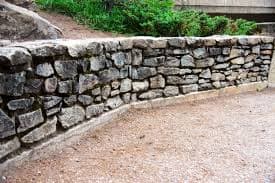
Fieldstone, flagstone, and stacked stone walls have a timeless, organic look that complements North Georgia's landscape perfectly. They're more labor-intensive to build because each stone is unique, but the result is a wall with character and visual warmth that block walls can't match. Natural stone ages beautifully and blends into wooded or rustic settings.
Timber
Pressure-treated landscape timbers offer a more rustic, casual look at a lower cost. They work well for small walls and raised beds. The tradeoff is longevity — timber walls typically last 10-15 years before the wood degrades, while stone and block walls last 30+ years with minimal maintenance.
Drainage Is Everything
The number one reason retaining walls fail is water. Hydrostatic pressure — water trapped behind the wall — builds up and eventually pushes the wall over or causes it to bow outward. Every properly built retaining wall includes a drainage system: gravel backfill, a perforated pipe at the base, and weep holes or drainage gaps.
Getting It Right
A retaining wall is a structural element, not just a decorative one. The foundation, drainage, and backfill all need to be done correctly or the wall won't last. We've seen plenty of DIY walls that looked great for a year and collapsed in year two. Our walls are built to engineering standards, with proper compacted base, drainage, and backfill — because a wall that moves isn't a wall.
READY TO GET STARTED?
Whether you need lawn care, hardscaping, or a full property transformation — we're here to help.
GET YOUR FREE ESTIMATE